
Written by Kelly Miyamoto
Genealogical Information
| Kometaro Hayami | Kise Sasaki Hayami | Shiro Waki | Kou Oki Waki | ||||||||||||||||||||||||||||||||
| Masato Hayami 1902 – ? |
Kaoru Waki Hayami 1908 – ? |
||||||||||||||||||||||||||||||||||
| Kathleen Hayami | Richard Hayami | June Hayami | Grace Hayami | George Hayami | Yoshio/Reginald Hayami | Hiroshi Hayami | Akiko Hayami | Michi Hayami | |||||||||||||||||||||||||||
George’s paternal grandfather, Kometaro Hayami, immigrated to Canada in 1900. His father, Masato Hayami, was born in British Columbia on June 24th, 1902 (despite records stating his DOB was in 1903) and was the oldest of five children. George’s grandparents later returned to Japan with two of their children, Yoshio and Chiyako, in February 1930.
George’s father married his mother, Kaoru Waki, in 1928. She was born in Hiroshima-ken. It is likely that his parents were married in Japan and then moved to Canada together in June 1928. Between 1930 and 1949, Masato and Kaoru had nine children. Kathleen, Richard, June, Grace, George, Yoshio (Reginald), Hiro, Akiko, and Michi. George was born in 1937, and his brother Yoshio was the last Hayami child to be born before the Japanese were evacuated from British Columbia.
George’s father, Masato, owned a business in Vancouver, called Hayami Wood and Coal. He shared an office space with his brother Shigeru, who owned a radio repair shop. The Hayamis lived in Vancouver until 1936, when they moved to Haney, British Columbia (now Maple Ridge), right after George was born. His family lived in Haney until they were forcibly removed from their home during WWII. Initially, the Hayamis were placed in Raymond, Alberta, where George’s father worked in a cannery for a few months. His father then asked the British Columbia Security Commission (BCSC) to move their family back to British Columbia, after which the Hayamis lived in the Bay Farm internment camp until 1946. George recalls his mother baking bread on a wood stove in Bay Farm and seeing the barracks/houses being moved around this site in pieces. He also remembers seeing the wells being drilled in the camp: “Hard work. Somebody with a sledgehammer on a pipe and somebody turning a pipe.” (35:45) In his interview, George clarifies that the Japanese did all the manual labour, saying: “You did everything yourself” (37:20).
Farnham Hostel
George was about ten years old when his family was relocated from Bay Farm to Farnham, Quebec. Why Farnham? George does not know. He is not sure if there even was a choice as to where his family was relocated (19:50). George hypothesizes that the Farnham Hostel may have been a place for Japanese families that had trouble finding residence or acceptance elsewhere in Quebec:
“I think the government had an issue. They couldn’t find anywhere they could send a [whole] bunch of people like us, but that was the problem. And Farnham had a prisoner of war camp there, a German prisoner of war camp. And they just took that over. When we went, when we arrived in Farnham, there were still a few Germans there. And we spoke to them. They didn’t want to leave Canada.”
George recalls the orchard that his father started before the war. Apple trees, plums, pears, and more. He had hoped that after retiring from the wood and coal business, he could tend to the orchard and enjoy what it produced. “But the war came,” George said. His father later tried to plant a few apple trees in Farnham. Unfortunately, the weather and soil did not cooperate, and he did not have the time to look after them.
The Hayami family lived in Farnham from 1946 until the early 1950s. In Bay Farm, George’s father drove logging trucks up and down the mountain. After moving to Farnham, he worked driving transport trucks. “Anybody that went through Farnham camp – the Japanese people – my dad moved them around,” George said (19:25). Among his regular transports were the Japanese students that attended Farnham Intermediate School, including George. He recalls that Japanese students made up about half of the student body, the other half being mostly white children. There were four rooms in the school, two classes per room, and about ten students per class. Behind the elementary school was a grassy patch that George and the other kids would flatten and flood in the colder months to use as a makeshift rink for playing hockey.
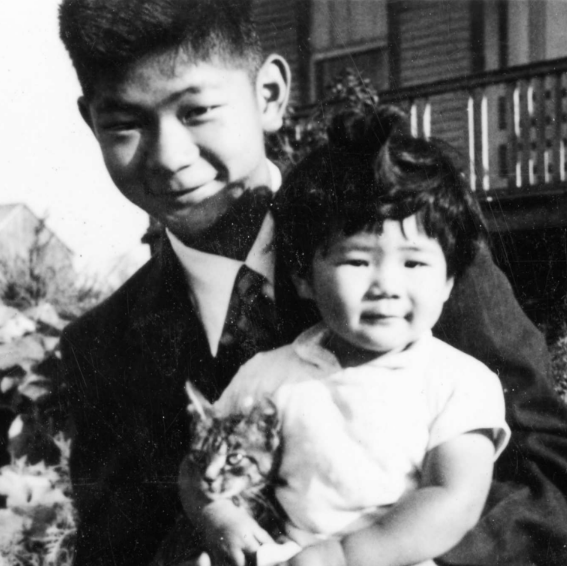
The entire family – George’s parents and all nine children – lived together in Farnham. George notes that big families made finding appropriate housing difficult, since there were not many spaces available for such large groups. After the majority of people left the hostel or were relocated, the Japanese Canadians that remained were given pieces of buildings or barracks, which they used to build their homes. Between 1946 and 1949, the Hayami family lived on the military base, in one of the larger barrack buildings next to the mess hall that was previously used for storage. The entire family stayed in one room.
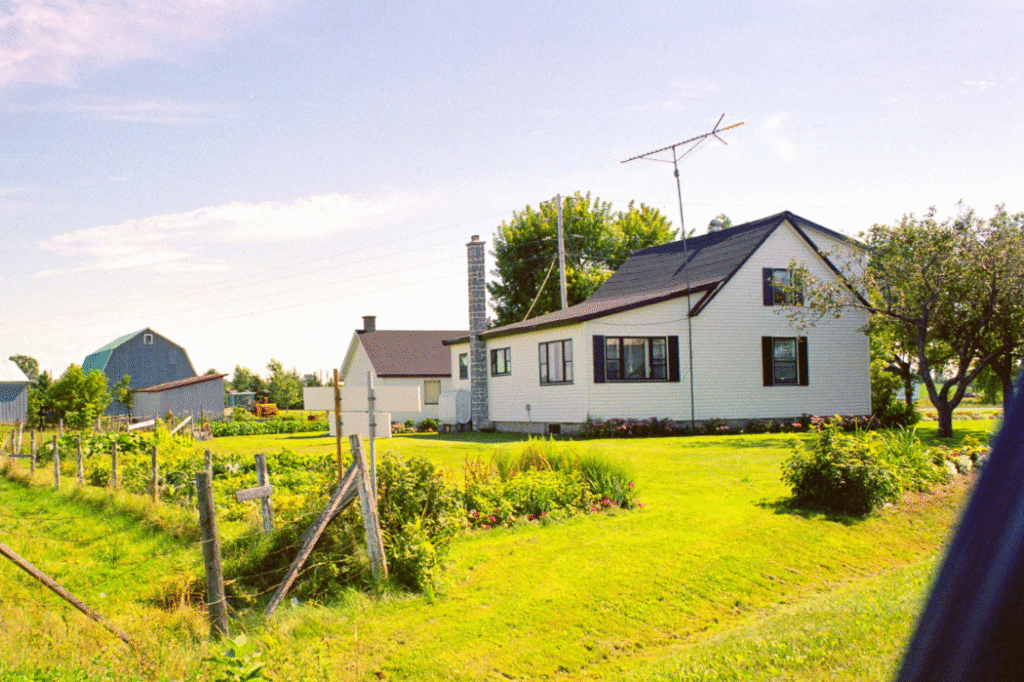
The Hayami family originally planned to move into a building on the eastern edge of Farnham, but George’s father ended up buying a farmhouse on Cowansville Road, where they lived until 1953 or 1954. After about a year or so of living in the farmhouse, some of the older Hayami children attended high school in Montreal.
George says he generally does not recall experiencing discrimination in neither Farnham nor Montreal. In fact, he said that he hardly saw any Japanese people in Montreal for a time. “It was like the culture,” he said. “You just disappear, don’t make a fuss.”
George left Farnham for Montreal in 1953 or 1954, primarily for economic reasons. At the time, he was not doing well academically, so his mother suggested that he enroll in a trade school in Montreal. The rest of the Hayami joined George and his sister Grace in Montreal about a year later. The Hayamis lived in NDG on Western Avenue – now de Maisonneuve.
George’s father went on to work at a linoleum factory in Montreal, alongside one of his brothers. After attending trade school, George was recruited by Bell Canada, where he worked for 45 years until retiring in 2002 or 2003. George stayed in Montreal from the 1950s until 2020. He married his wife Margaret and they had two children, a son and a daughter. George and Margaret moved to Calgary in 2020, but his nephew still lives in Montreal. Of the nine Hayami children, only three are still alive.
George has been back to visit Farnham several times over the years, mostly to see the old farmhouse. As the memorial project takes shape, George would like to give thanks to the people of Farnham for being so accepting of the Japanese Canadians displaced there postwar. He would also hope that the history of what happened is made clear. “Mention why we were there, you know,” he said. “Because of [the] injustice.”
Excerpt from George Hayami’s book:
FARNHAM I have only vague memories of our trip East, the long train ride, the mountains, the long tunnels, the boring prairies and sleeping on the uncomfortable cane seats. Farnham, our final destination, is a small industrial town about 40 miles east of Montreal in the Eastern Townships, an area of Quebec with a large population of mostly Protestant Anglophones, descendants of the British who migrated to Canada after the American War of Independence. The Farnham camp was previously a military facility. When we arrived in August 1946, there were still a few German prisoners of war there. Now, it was being used as temporary housing for the Japanese arriving from BC. A large building served as a kitchen and mess hall. In a room at one end of another large building was where our family lived until we moved to a house on Cowansville Road in late 1947. For the ten families who decided to remain in Farnham when the camp closed in 1947, the government offered each a part of a barrack building which was moved to other parts of the town. We were given the building that was used as a clinic. With funds from the custodian sale of his property in BC, my father bought a 20-acre property with a house on the highway to Cowansville. There was no basement or plumbing. A wood burning kitchen stove provided heating. After we moved, the basement was dug deeper, a concrete floor was poured and an electrical water pump was added to the well. The shed was demolished and the house was enlarged with a kitchen and dining area and a bathroom. A septic tank and a water softener were installed. A separate garage was built later. For schooling, we attended the Farnham Intermediate School, a Protestant Anglophone school for Grades 1 to 8. Classes were small with two grades and one teacher in each classroom. Japanese kids often outnumbered the white kids. We walked 2 [kilometers] to school from the camp. For high school, we had to go to Cowansville or Montreal. Kathleen went to Commercial High in Montreal where she graduated as a valedictorian and Richard placed second in the Provincial High School Leaving Exam at Montreal High School. June and Grace were “school girls”, June for a doctor’s family and Grace for a Jewish lady. They came home to Farnham on weekends. I travelled by bus to Cowansville High for Grade 9, then commuted by train to Montreal Technical School. Yoshi went to a trade school and Hiro followed me at Montreal Technical School. Aki got her Arts degree at McGill University, then continued at the University of Toronto. Michi got a full scholarship to McGill University.